Buy used Tiny House: Inspection checklist, prices and red flags
A used Tiny House can save several tens of thousands of euros – or become an expensive bad purchase. This guide shows where to look, how to check moisture, statics, approval and documents with a clear checklist and what used models cost in 2026. In addition the differences between private and dealer purchase and typical warning signs.
A used Tiny House promises entry into minimalist living at a fraction of the new price – and sometimes even with a fully furnished kitchen and clarified placement. However the used purchase has its pitfalls: moisture damage remains invisible from the outside, the road approval is not always up to date, documents are missing, and with private purchase the warranty is omitted. This guide leads you through the right search, a robust inspection checklist, the realistic price level 2026 and the legal differences between private and commercial purchase – so that the bargain does not become an expensive bad purchase. A broader overview is provided by our guide Modular house: prices & providers.
Is it worth buying a used Tiny House?
Short answer: A used Tiny House can be worthwhile if you are looking for an affordable, already furnished property and tackle the inspection carefully. Used prices typically lie at 40 to 70 % of the new price so that several tens of thousands of euros can be saved. The risk lies in hidden defects – above all moisture, static problems and missing documents – as well as the warranty excluded in private purchase. Those who inspect a used model expertly (or have it inspected) and check the papers can make a fair deal; those who buy blind risk expensive surprises.
Unlike a new purchase, with the used purchase you bear the risk for the condition largely yourself. Exactly for this reason the inspection is not a side issue but the core of the purchase decision. Those who know the price regions for new Tiny Houses can better classify used offers – the overview is provided by the Tiny house costs.
Where to find used Tiny Houses?
Short answer: Used Tiny Houses are found mainly on three paths: via private classified portals (largest selection but without warranty), via dealers and manufacturers that offer inspected returns or show pieces (more security, usually higher price), and via auctions and insolvency realizations (potentially cheap but without inspection possibility). Each path has its own relationship of price, selection and protection – choose it appropriate to your security needs.
Sources for used Tiny Houses
| Source | Selection | Price | Protection / risk |
|---|---|---|---|
| Private classifieds | very large | often affordable | no warranty |
| Dealer / manufacturer | limited | higher | warranty possible |
| Auction / realization | varying | potentially low | mostly without inspection |
| Show home clearance sale | low | discounted | Condition mostly well documented |
Independent of the source the following applies: An offer without viewing and without complete papers is a warning signal. Take time for the selection and do not let yourself be pressured by a supposedly unique bargain. Those who prefer to buy new instead of used find the complete process in the Guide Tiny House purchase as well as an overview of building methods at the Tiny house types.
The inspection checklist before purchase
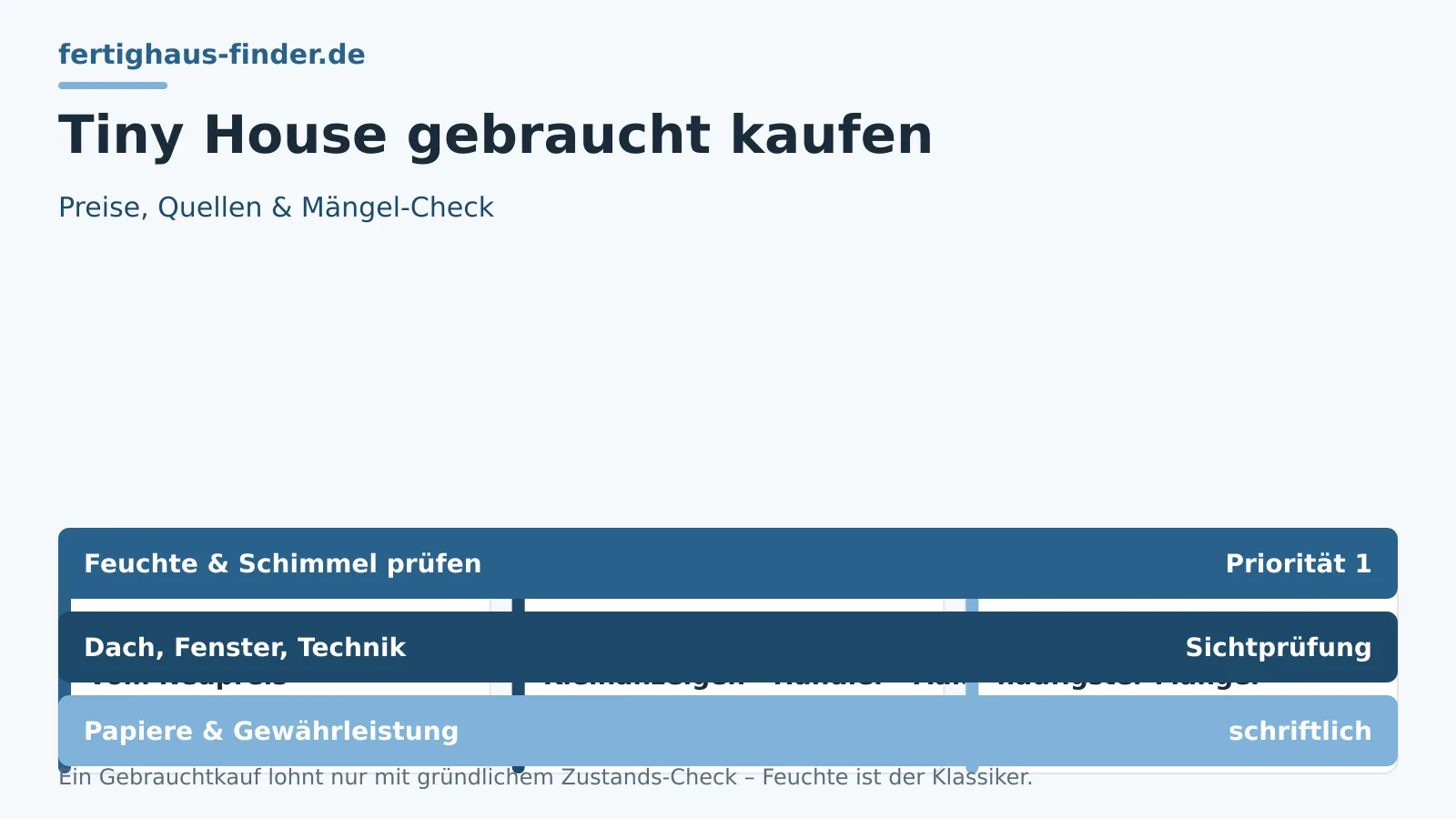
Short answer: Before the purchase of a used Tiny House you systematically check five areas: the building fabric for moisture and mold, the statics and the trailer or the foundation, the house technology (electricity, sanitation, heating), the approval or permit as well as the complete documents. Check particularly carefully for moisture in corners, under windows and in the floor construction – here the most expensive defects hide. In case of doubt consult a building expert; the costs are low measured against the risk of a bad purchase.
- Moisture & mold: control corners, window reveals, bathroom and floor construction; musty smell is an alarm sign.
- Statics & base: for mobile houses check trailer, axles and frame for rust and deformation, for fixed houses the foundation.
- Roof & shell: examine roof skin, connections and windows for leaks and water traces.
- House technology: test electricity, heating, water and wastewater and ask for maintenance or test proofs.
- Approval / permit: for vehicles with wheels valid road approval, for fixed houses check the building permit and type of use.
- Documents: purchase contract, building description, invoices, vehicle papers and maintenance proofs completely review.
Take a flashlight, a moisture measuring device and ideally an expert companion with you for the viewing. Check the house in daylight and – if possible – not only in dry weather, because leaks show themselves most readily after rain. A serious seller will not shy away from a thorough viewing.
Used or new – compare prices fairly
So that you can assess whether a used offer is really affordable, it is worth looking at current new prices. Request offers for new Tiny Houses and compact houses free of charge and without obligation – with clear performance description and fixed price as a comparison measure.
Price level: used versus new
Short answer: Used Tiny Houses generally cost in 2026 40 to 70 % of the comparable new price - depending on age, condition, equipment and whether a parking space is sold with it. A mobile Tiny House loses value faster similar to a vehicle, a fixed mini house on its own land holds the value better. Very low prices almost always indicate defects, missing papers or registration problems and should prompt you to particularly thorough inspection, not to a quick purchase.
Orientation: Used compared to new price (Tiny House ~20 m²)
| Age / Condition | Proportion of the new price | Reference value 2026 |
|---|---|---|
| Almost new (0-2 years) | 70–85 % | 45.000–75.000 € |
| Used, well maintained (3-6 years) | 55–70 % | 35.000–60.000 € |
| Older / in need of renovation | 40–55 % | 25.000–45.000 € |
| With defects / without papers | under 40 % | Caution advised |
Always calculate the ancillary costs in addition to the purchase price: transport to the new location, any repairs, adaptation to the parking space and if necessary a new road registration or permit. A favorable purchase price quickly becomes relative if several thousand euros then flow into the restoration. With our calculator the Calculate prefabricated house costs and various equipment options can be simulated individually.
Private or commercial purchase - the legal differences
Short answer: The most important legal difference concerns the warranty: When buying from a private seller the warranty is generally effectively excluded - you buy as seen and bear the defect risk yourself. If instead you buy from a commercial seller (dealer, manufacturer), the statutory warranty applies, which for used goods can be shortened but not completely excluded. For buyers this means: With a private purchase only your own inspection counts, with a commercial purchase there is statutory backing.
Deliberately concealed defects cannot be shifted by a private seller even with a warranty exclusion - however you must prove the deliberate deception, which is difficult in practice. Therefore always have assured properties and the condition confirmed in writing in the purchase contract. What a robust construction contract should contain can be applied analogously to the Tiny House purchase and is covered in more detail in the guide Buying a Tiny House covered in more detail.
As seen is no free pass for the seller - but almost
Never rely on verbal promises with a private purchase. Record in the purchase contract the condition, included equipment, registration status and the agreed handover date. A detailed contract protects both sides and is the only robust basis in later disputes.
Red flags: When it is better to refrain
Short answer: Refrain if a seller refuses the inspection, documents are missing or only available as copies, the price is noticeably far below the market, damp spots or mold smell are present or pressure is applied for quick deposit without personal handover. Also a missing or expired road registration for the mobile Tiny House and an unresolved permit for the fixed house are serious warning signs. These signals individually or in combination are a good reason not to make the purchase.
- Seller refuses inspection or pressures for quick completion.
- Documents are missing, incomplete or only available as a copy.
- Price is noticeably far below the realistic market level.
- Damp spots, mold smell or freshly painted water stains.
- Deposit or full payment required without personal handover.
- Road registration expired or building permit unresolved.
A used Tiny House can be a wise decision - if you invest time in inspection and papers and do not let a good gut feeling override hard facts. Always compare in parallel with new purchase, because sometimes the safety gain of a new, warranted house is worth the premium. Further orientation is provided by the guide Tiny House Costs and the overview of the Tiny House types. How used and new prices can be classified is shown by the Tiny House Price Comparison; a general introduction is offered by the Tiny House, and the suitable location is clarified by the guide Finding a Tiny House Building Plot. Anyone looking for an even more compact, prefabricated alternative will find the suitable overview in the guide Buying a Capsule House the suitable overview.
Buy safely instead of expensive follow-up work
Especially with used purchases a benchmark is invaluable. Request free and non-binding offers for new Tiny Houses and compact houses - with transparent building description, fixed price and warranty. This way you can immediately see if a used offer is really fair.
What does your desired house really cost?
Request free suitable offers from verified manufacturers and compare the square meter prices for your construction project.
Compare house prices nowImportant questions explained briefly
The most common price questions about buying a used Tiny House - compactly answered by the editorial team of hausbau-grundrisse (Stand 2026).
